Rooftop
Wind Solutions
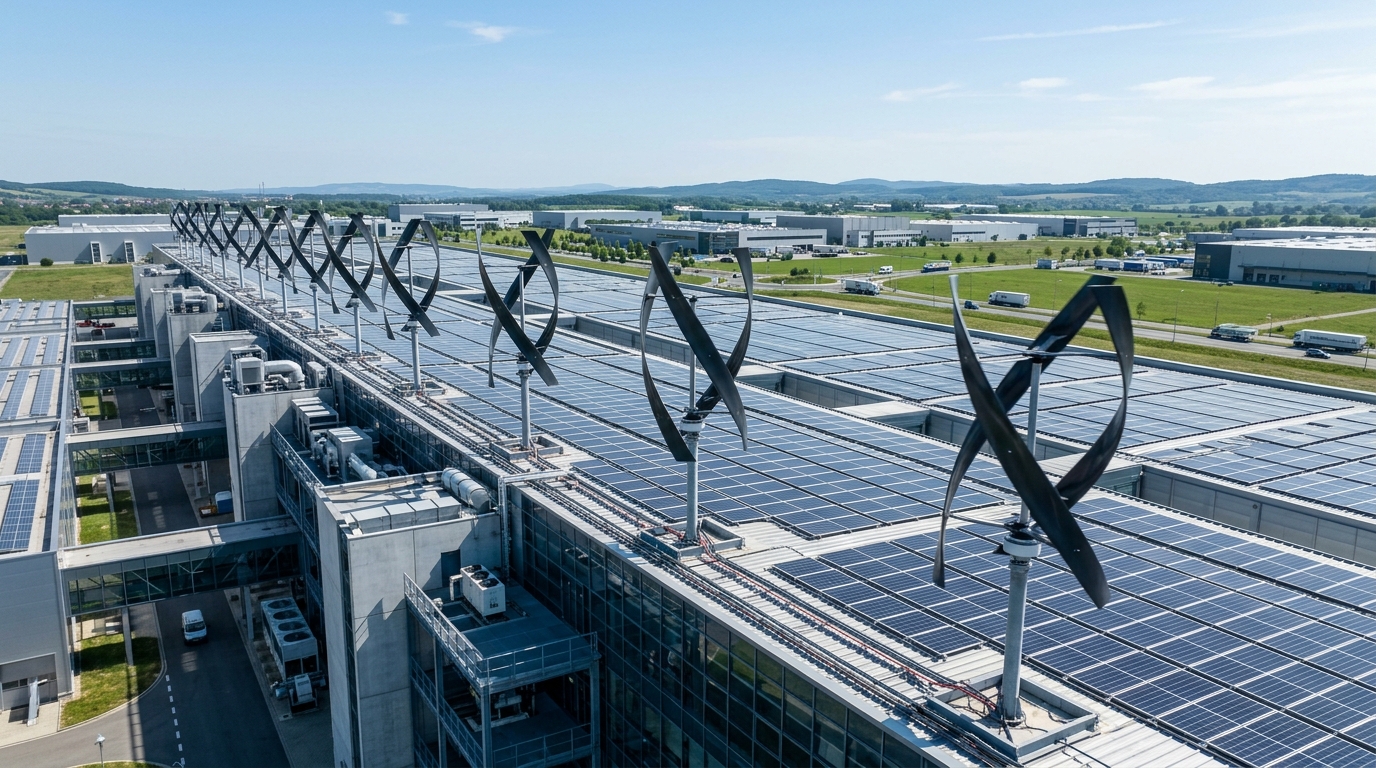
Ultra-silent, vertical-axis micro-wind turbines designed for industrial parapets and factory roofs. Generating clean power day and night to complement your solar arrays.
2.5 m/s
Cut-In Wind Speed
24/7 Yield
Night & Day Generation
Harvesting the Urban Wind Profile
While traditional horizontal wind turbines require vast rural land buffers, modern vertical-axis wind turbines (VAWT) are specifically engineered to thrive on building edges, parapets, and rooftop elevations where aerodynamic draft velocities are naturally magnified.
Combined with industrial rooftop solar, wind creates a synergistic hybrid microgrid: solar powers heavy daytime machinery, while wind continues spinning through monsoons, cloud cover, and night shifts.
- Omnidirectional Wind Harvesting (No Directional Yaw Motor)
- Multi-Stage Resonant Vibration Dampening Mounts
- Ultra-Quiet Acoustic Footprint (<35 dBA at Base)
Core Wind Offerings
Engineered to integrate seamlessly with industrial civil structures and electrical switchgear.
Vertical-Axis Helical Turbines
Aerodynamic curved aerofoils that harness turbulent gusts from 360 degrees without mechanical gearing or friction-heavy yaw mechanisms.
Solar-Wind Hybrid Microgrids
Dual-generation architecture routed through intelligent hybrid inverters with battery energy storage (BESS) for round-the-clock facility power reliability.
Parapet & Structural Mounts
Engineered non-penetrating clamping assemblies and elastomeric shock-absorption pads that secure to main factory pillars with zero roof membrane perforation.
The Wind Implementation Workflow
Anemometric Wind & Structural Audit
Deploying precision sonic anemometers to log building-edge wind speeds, prevailing vector distributions, and STAAD.Pro structural load capacities.
Vibration Isolation & CAD Design
Finite Element Analysis (FEA) modeling to isolate structural vibration harmonics, specify elastomeric dampeners, and engineer aerodynamic spacing.
Mechanical Rigging & Parapet Clamping
Precision on-site assembly of lightweight carbon-fiber rotor blades, direct-drive permanent magnet generators (PMG), and storm-rated mast fixtures.
Hybrid Inverter Synchronization
Connecting turbines to hybrid MPPT controllers, automated electromagnetic brake systems, and unified cloud monitoring dashboards.